<?xml version="1.0" encoding="utf-8"?><feed xmlns="http://www.w3.org/2005/Atom" ><generator uri="https://jekyllrb.com/" version="4.2.2">Jekyll</generator><link href="https://www.craig-james-stewart.co.uk/blog/feed/entries/atom" rel="self" type="application/atom+xml" /><link href="https://www.craig-james-stewart.co.uk/" rel="alternate" type="text/html" /><updated>2023-01-22T10:01:23+00:00</updated><id>https://www.craig-james-stewart.co.uk/blog/feed/entries/atom</id><title type="html">My Blog</title><subtitle>The Personal Blog of a Geek</subtitle><entry><title type="html">The Nature of the Soul</title><link href="https://www.craig-james-stewart.co.uk/blog/2023/01/07/the-nature-of-the-soul.html" rel="alternate" type="text/html" title="The Nature of the Soul" /><published>2023-01-07T20:44:00+00:00</published><updated>2023-01-07T20:44:00+00:00</updated><id>https://www.craig-james-stewart.co.uk/blog/2023/01/07/the-nature-of-the-soul</id><content type="html" xml:base="https://www.craig-james-stewart.co.uk/blog/2023/01/07/the-nature-of-the-soul.html"><![CDATA[<p>The other day I saw someone ask if a robot could have a soul. The question was a rhetorical one, and they were making the point that if you ignore the possibility of a sentient robot having a soul, well that was not a good look. The thing is, I’m an atheist, so I don’t believe the robot could have a soul, but apart from the soul I think I largely agree with the point they were trying to make. It’s not about the soul as such, it’s about how you treat others, and specifically how you treat sentient beings not like you. And this got me to thinking, and I ended up thinking some pretty dark thoughts. So here I shall lay out my theory, as an atheist, of what the soul is.</p>

<p>The short version, it’s an idea used to justify evil, and to control people in fear.</p>

<p>The less short version. The soul is an idea that crosses religious boundaries, all religions that I know of have something like the soul in their belief system. It is the thing that makes you “you”. It is ephemeral, and it is, normally, immortal. When you die it does not, it goes on, through reincarnation, or to the next life. Christians have the soul going to heaven, if you have been good, or to hell, if you have not. And that brings us to the second part of the short version, control. I don’t think the idea of the soul started out as a mechanism for control, it was something to help the bereaved cope with their loss, the dead haven’t suddenly gone, they have moved on to a better place. But religion is lead by people, and give people power and they will abuse it. So the religious leaders pushed scare stories about what might happen to your soul if your were not good, and who better to decide what was good or not but those who understood the words of our Gods? And so being wicked tarnished your soul, and being good polished it.</p>

<p>Now that we have an idea that can control people, we can make those people do evil things, but how, evil is punished. Well what about not hurting each other, that tarnishes the soul, but what if it is only hurting others who have a soul that tarnishes your soul? Wouldn’t you then be free to hurt others who do not have a soul? And it is this very question, that I think is the crux of the initial question that led me down this path, but also how the soul is used to justify evil. Look at history, and you will find arguments for why one group or other does, or does not, have a soul, and so therefore cruelty towards them is, or is not, justified. Cruelty for it’s own sake is never justified, and that is the point being made initially, but it is an argument that has been made before, and I have no doubt it will be made again.</p>

<p>So I do not believe the robot could have a soul, but neither do I. So if the robot is sentient I should treat it as I wish to be treated, for we are the same. Even if it is hard to see.</p>]]></content><author><name>Craig Stewart</name><email>craig@craig-james-stewart.co.uk</email></author><category term="comment" /><category term="opinion" /><category term="thinking" /><summary type="html"><![CDATA[The other day I saw someone ask if a robot could have a soul. The question was a rhetorical one, and they were making the point that if you ignore the possibility of a sentient robot having a soul, well that was not a good look. The thing is, I’m an atheist, so I don’t believe the robot could have a soul, but apart from the soul I think I largely agree with the point they were trying to make. It’s not about the soul as such, it’s about how you treat others, and specifically how you treat sentient beings not like you. And this got me to thinking, and I ended up thinking some pretty dark thoughts. So here I shall lay out my theory, as an atheist, of what the soul is.]]></summary></entry><entry><title type="html">Why don’t liberal arguments work against illiberal ideas?</title><link href="https://www.craig-james-stewart.co.uk/blog/2022/10/16/liberal-arguments-against-illiberals.html" rel="alternate" type="text/html" title="Why don’t liberal arguments work against illiberal ideas?" /><published>2022-10-16T17:40:00+01:00</published><updated>2022-10-16T17:40:00+01:00</updated><id>https://www.craig-james-stewart.co.uk/blog/2022/10/16/liberal-arguments-against-illiberals</id><content type="html" xml:base="https://www.craig-james-stewart.co.uk/blog/2022/10/16/liberal-arguments-against-illiberals.html"><![CDATA[<p>This is a topic that has been on my mind for a while. I don’t claim to have all the answers, and I am in no way qualified to make determinations about the topics that this post is going to touch on. But this is going to be an overview of what I believe on the matter.</p>

<p>First of the all one of the major hurdles liberal people face when arguing against illiberal ideas is the fact that the people that hold any given illiberal idea are not a homogeneous group. Each individual will hold that idea for a different, personal, reason. I believe this is a fact that is well understood, and I don’t have any useful insight here, so I am going to move on.</p>

<p>My next point needs us to group those holding our hypothetical illiberal idea into two broad groups. The first group is made up of people who know that the idea is illiberal, and don’t care, largely this group don’t see themselves as being potential victims of the illiberal idea, so the tactic for arguing with this group is to show them how the illiberal idea can be turned against them. Again I have no real insight here, and no real solution to arguing with this group, my insight (I think) is that this group is a tiny minority. It is in fact the second group, who do not see the idea as illiberal, that poses the problem, showing them how they could be the victim is either harder, because they cannot see how they would be the victim, or because they do not think the cost to them is a cost not worth paying. It is this second group I wish to discuss further.</p>

<p>So the people I wish to talk about, and the group who I think liberal people struggle hardest to argue against are people who hold an illiberal idea, but do not see it ass illiberal. The obvious question is how this can possibly be, and the answer is depressingly simple. People are often stupid and inconsistent. I don’t say this to lord it above others, I am also often stupid and inconsistent, and knowing this does not make me immune from being stupid and inconsistent in future. A more accurate way to say what I want to say is that people suffer from <a href="https://en.wikipedia.org/wiki/Cognitive_dissonance" title="Cognitive dissonance">cognitive dissonance</a>, they are able to hold two contradictory “facts” as absolutely true at the same time. They don’t see themselves as illiberal, they believe that everyone should be free to be themselves, and do as they please, as long as that freedom doesn’t harm others, or encroach on the freedoms of others. And yet they also believe people should not be allowed to be, or do, a “thing” that is obviously of no material effect on others. The problem here, is that to show this person why they are being illiberal it is not enough to show that being illiberal in this way could harm them.</p>

<p>They must have some justification for thinking they are not being illiberal, and so showing how they could be harmed will just result in them accepting that harm as a justified harm. You need to get to the root of what makes them think that the “thing” is not acceptable. This will depend heavily on what the “thing” is. Allow me a particularly tortured example. A white man not liking black men in his neighbourhood, is clearly racist, but they may not believe they are racist, they may consider crime statistics, absent any proper context, and use that to justify their dislike of the black men, or they could latch onto some other “fact” that reinforces their position. Of course the “right” black man would be fine, but those black men are the wrong sort, not because they are black by itself, but because by being black they are more likely to be something else that is undesirable. And so it is, I believe, with most people holding illiberal ideas, they have found a “reason” to justify their position, that fits within a liberal framework.</p>

<p>All we have to do now is show them why they are wrong, not why being illiberal is wrong, but whatever their reasoning is, is wrong. And this is where the work gets hard, because these people will all have different justifications, and so the arguments that work against deliberately illiberal people are directly applicable, but entirely unhelpful here. We need to understand the audience better, to understand what they use to justify their position, and then we must find the facts, in context, that show them to be wrong. And presenting these facts, in context, in a compelling way may not be easy.</p>]]></content><author><name>Craig Stewart</name><email>craig@craig-james-stewart.co.uk</email></author><category term="comment" /><category term="opinion" /><category term="thinking" /><summary type="html"><![CDATA[This is a topic that has been on my mind for a while. I don’t claim to have all the answers, and I am in no way qualified to make determinations about the topics that this post is going to touch on. But this is going to be an overview of what I believe on the matter.]]></summary></entry><entry><title type="html">Oh Dear, That Was a Long Pause</title><link href="https://www.craig-james-stewart.co.uk/blog/2022/10/13/long-pause.html" rel="alternate" type="text/html" title="Oh Dear, That Was a Long Pause" /><published>2022-10-13T19:02:00+01:00</published><updated>2022-10-13T19:02:00+01:00</updated><id>https://www.craig-james-stewart.co.uk/blog/2022/10/13/long-pause</id><content type="html" xml:base="https://www.craig-james-stewart.co.uk/blog/2022/10/13/long-pause.html"><![CDATA[<p>It’s been a while.</p>

<p>First off, it would appear that my last blog post was not well considered, the light we could see did in fact turn out to be an oncoming train instead of the light at the end of the tunnel. Sorry.</p>

<p>There have been a number of things I’ve considered posting to my blog, but there has been <em>so much</em> going on that it didn’t feel appropriate. On top of that I have simply not been in the right head space to deal with this blog. This has been down to a combination of things happening in my personal life, and the shear insanity of the last couple of years. Hopefully this post will mark the start of me continuing to add posts, but nothing about this blog is as well planned as I would like to admit, so we shall see.</p>]]></content><author><name>Craig Stewart</name><email>craig@craig-james-stewart.co.uk</email></author><category term="comment" /><summary type="html"><![CDATA[It’s been a while.]]></summary></entry><entry><title type="html">Happy New Year</title><link href="https://www.craig-james-stewart.co.uk/blog/2021/01/03/happy-new-year.html" rel="alternate" type="text/html" title="Happy New Year" /><published>2021-01-03T13:42:00+00:00</published><updated>2021-01-03T13:42:00+00:00</updated><id>https://www.craig-james-stewart.co.uk/blog/2021/01/03/happy-new-year</id><content type="html" xml:base="https://www.craig-james-stewart.co.uk/blog/2021/01/03/happy-new-year.html"><![CDATA[<p>I don’t have much to say for this post. But 2020 was a hell year for most of us, and despite the hope that is now present thanks to various developments I doubt anything is going to improve substantially for at least a few months. So I just wanted to say to anyone paying attention, we’ve survived 2020, we can get through the first few months of 2021, and lets all hope the light we can now see is the end of the tunnel, and not an oncoming train.</p>]]></content><author><name>Craig Stewart</name><email>craig@craig-james-stewart.co.uk</email></author><category term="comment" /><summary type="html"><![CDATA[I don’t have much to say for this post. But 2020 was a hell year for most of us, and despite the hope that is now present thanks to various developments I doubt anything is going to improve substantially for at least a few months. So I just wanted to say to anyone paying attention, we’ve survived 2020, we can get through the first few months of 2021, and lets all hope the light we can now see is the end of the tunnel, and not an oncoming train.]]></summary></entry><entry><title type="html">Further thoughts on Identity</title><link href="https://www.craig-james-stewart.co.uk/blog/2020/09/20/further-thoughts-on-identity.html" rel="alternate" type="text/html" title="Further thoughts on Identity" /><published>2020-09-20T17:55:00+01:00</published><updated>2020-09-20T17:55:00+01:00</updated><id>https://www.craig-james-stewart.co.uk/blog/2020/09/20/further-thoughts-on-identity</id><content type="html" xml:base="https://www.craig-james-stewart.co.uk/blog/2020/09/20/further-thoughts-on-identity.html"><![CDATA[<p>Some time ago I wrote a blog post asking the question <a href="/blog/2019/06/16/who-are-you-really.html" title="Who are you really?">“Who are you really?”</a> It didn’t come to any real conclusion, it only expressed the fact that it was a topic I had been thinking about. I didn’t immediately stop thinking about it, but it drifted out of the forefront of my thoughts to the point that I still haven’t really got a good conclusion. But I have been reminded of the topic recently by an article on LWN about <a href="https://lwn.net/SubscriberLink/831401/4170e588cdfdfc7f/" title="Key signing in the pandemic era">issues Debian is facing with key signing</a>. Now the issues that Debian is facing very much reflect the issues I had that led to my previous blog post. How do you trust an identity? What value does that identity hold in itself, and what value can you ascribe to associated details.</p>

<p>This leads me to lean more and more towards the idea that we place too much value on a single physical body as the “true” identity, and all other aspects are chained to this. To an open source project the value of the identity isn’t in a warm body, but in the contributions they make. Now the discussion within the debian project appears to be headed that way, and this I think is the correct way to handle that. But this also raises a question of trust. Our society has largely developed systems of trust based around individual interactions, and it is easier to build trust if these interactions are face to face. Many would probably argue that this means I am wrong to like the movement away from chaining online digital identities to physical people, but I would like to suggest that fewer of our face to face interactions are the sort that should build trust, or are with the entities that we should be trusting. Banking is done increasingly online, and even when it isn’t the person at the bank you deal with is likely to have very little discretion to alter the possible outcomes much. Trusting the bank clerk works in the bank’s favour, but a trustworthy bank clerk doesn’t mean the bank is trustworthy. Similarly supermarkets, ISPs, Utility providers, etc, are all large organisations that manipulate our ingrained trust mechanisms to make it easier to take our custom, but they don’t build trust in us based on the individual interactions we have, but rather through data-mining done by credit reference agencies, and information about us on public record. This I think demonstrates that our current trust mechanisms have failed individuals, and we need to build new ones, and we may as well do so in a way that allows us to separate our identities, such that they can be trusted for what they are, and not who we are, or who we were.</p>

<p>I think the obvious conclusion to all this is that I believe we should all have as many, or as few, identities as we are comfortable maintaining. These identities should stand or fall on their own merits, and that we need to find new ways to develop trust online that are appropriate to whatever activities we value online. I don’t know what these mechanisms for trust should be, or how they should look, but I do believe developing them is not beyond the wit of humanity.</p>

<p>I still haven’t really got a firm idea of how I think these disparate identities should be formed, or how they could be used. I also worry this is a sign that I may be slipping back into behaviours that I found to be damaging to my mental health. On the former I’m sure more developments will help push my thoughts in the right direction, on the later I shall keep an eye on it, but my compartmentalisation in the past came out of a bad place, and I don’t think these ideas do, I’m not trying to hold aspects of my life apart artificially, but trying to recognise where the natural boundaries lie.</p>]]></content><author><name>Craig Stewart</name><email>craig@craig-james-stewart.co.uk</email></author><category term="opinion" /><category term="thinking" /><category term="comment" /><summary type="html"><![CDATA[Some time ago I wrote a blog post asking the question “Who are you really?” It didn’t come to any real conclusion, it only expressed the fact that it was a topic I had been thinking about. I didn’t immediately stop thinking about it, but it drifted out of the forefront of my thoughts to the point that I still haven’t really got a good conclusion. But I have been reminded of the topic recently by an article on LWN about issues Debian is facing with key signing. Now the issues that Debian is facing very much reflect the issues I had that led to my previous blog post. How do you trust an identity? What value does that identity hold in itself, and what value can you ascribe to associated details.]]></summary></entry><entry><title type="html">My shed now has a couple of shelves</title><link href="https://www.craig-james-stewart.co.uk/blog/2020/08/08/shed-shelves.html" rel="alternate" type="text/html" title="My shed now has a couple of shelves" /><published>2020-08-08T15:50:00+01:00</published><updated>2020-08-08T15:50:00+01:00</updated><id>https://www.craig-james-stewart.co.uk/blog/2020/08/08/shed-shelves</id><content type="html" xml:base="https://www.craig-james-stewart.co.uk/blog/2020/08/08/shed-shelves.html"><![CDATA[<p>In my previous blog post about my shed I teased about a wireless access point, and that it would be the subject of a future blog post. I had intended that to be the next enhancement to my shed that I blogged about. Unfortunately having had a shed for a few weeks now, and stuff that needs somewhere to live (the point of buying the shed in the first place), my wife insisted that the shed should be used for storage. It’s not like I didn’t want this as well, so I have had to re-prioritise my sub-projects within the shed. So once again that will have to wait. This week I have built a set of two shelves.</p>

<p>So I haven’t taken many pictures this time. There may also have been a certain amount of swearing involved in the construction of these shelves. So being the intelligent, self sufficient, practical chap that I am* I decided that rather than buying shelves pre made I would be able to construct some shelves out of wood that are bespoke to my shed. Similar to the bike rack I’ve used wooden beams that are the same size as the structure of the shed, I have also used 15mm chip board for the shelves themselves. How hard could it be?</p>

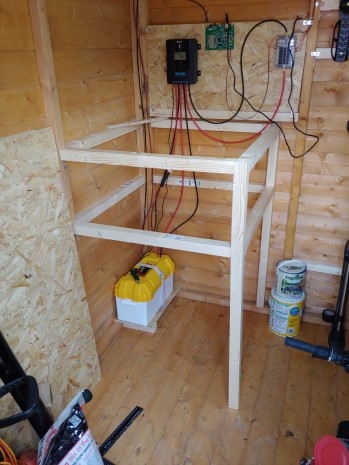
<p>Well it turns out that was probably a mistake. Hence the possibility of swearing being involved. I started by measuring where I wanted the shelves to go. I wanted the supports to be resting on structural members of the shed, and as one of the upright supports of the back of the shed lined up with one of the structural members under the floor I used that rather than having to cut too many uprights. I also used the very back corner as one of the uprights. I then cut two new uprights, one that rested at the back of the shed, and one that stood out next to where my bike was hanging. I joined these all together with two levels of the cross members. I may have done this in the wrong order. And the decision not to attach the new uprights to the floor where they stood was certainly a bad choice. Once again I have used corner braces to support the weight. This gave me a frame on which I could build my shelves.</p>

<p><img src="/images/2020/08/08/shed-shelves/shelf-frame.jpg" alt="wooden frame in the back corner of my shed" /></p>

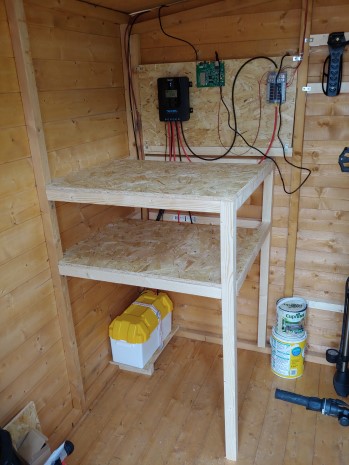
<p>This frame is reasonably sturdy, but as I built the bit closest the camera in that shot first the rest of it involved quite a lot of swearing. And the corner braces I used are slightly less than 90 degrees, they pull out to 90 degrees easily enough when you screw them in, if what you’re screwing them into is suitably supported. This meant I was constantly battling the position of the uprights as I attached the first cross members to them. However once I got it all set up it was sturdy enough to support my weight, so I’m confident I won’t have any trouble with it. Onto this frame I put some 15 mm chip board. Alas the chip board I bought wasn’t big enough to fully cover the frame, so I do need to get some more and cut it to fill a gap at the back of the shelving. But as it stands it has plenty of room, and doesn’t look too bad if I say so myself.</p>

<p><img src="/images/2020/08/08/shed-shelves/shed-shelves.jpg" alt="completed shelves" /></p>

<p>I’ve already started to use the shelves, so I may or may not get around to filling the gap at the back. But as I’m going to have to cut channels in the bard for the wires for the solar charger and battery that was more complex than the cuts I needed to make for the boards where they are now. But the Shed is now in use for storage of more than just our bikes, so my wife is reasonably happy.</p>

<p>*Also possibly deluded.</p>]]></content><author><name>Craig Stewart</name><email>craig@craig-james-stewart.co.uk</email></author><category term="project" /><category term="shed" /><summary type="html"><![CDATA[In my previous blog post about my shed I teased about a wireless access point, and that it would be the subject of a future blog post. I had intended that to be the next enhancement to my shed that I blogged about. Unfortunately having had a shed for a few weeks now, and stuff that needs somewhere to live (the point of buying the shed in the first place), my wife insisted that the shed should be used for storage. It’s not like I didn’t want this as well, so I have had to re-prioritise my sub-projects within the shed. So once again that will have to wait. This week I have built a set of two shelves.]]></summary></entry><entry><title type="html">Migrating my blog workflow to WSL</title><link href="https://www.craig-james-stewart.co.uk/blog/2020/08/02/migrating-to-wsl.html" rel="alternate" type="text/html" title="Migrating my blog workflow to WSL" /><published>2020-08-02T21:30:00+01:00</published><updated>2020-08-02T21:30:00+01:00</updated><id>https://www.craig-james-stewart.co.uk/blog/2020/08/02/migrating-to-wsl</id><content type="html" xml:base="https://www.craig-james-stewart.co.uk/blog/2020/08/02/migrating-to-wsl.html"><![CDATA[<p>I’m a Linux systems administrator. This means I am not as skilled at supporting and maintaining windows based systems as I am Linux systems. As such my personal laptop has Debian installed, and I have a number of Debian servers (some hosted at a VPS provider, some at home). I also have a Desktop that I built myself, using high spec components (at the time). As the desktop was intended to be used for gaming I bought a Windows license for it. At the time the intent was to install Debian, and then create a KVM virtual machine to run Windows in. However out of impatience, laziness, and hubris (I could always fix it later right?) I installed windows directly onto the system drive. And now the hinge on my laptop lid is broken. As my blog is split across two git repositories (one private, and one public) and publishing new posts involves a workflow that requires me to use a number of linux based systems this is a sub-optimal state of affairs.</p>

<p>So the work flow as it is involves the private git repository, which contains my site as a jekyll site. This is checked out on my laptop, and I make edits using vim. I use jekyll to serve a version of this site on localhost whilst I am making changes to ensure I am happy with how it looks (well as happy as I can be given the design, I still need to work on that). These changes are then built to a directory that is a copy of the public repository also checked out on my laptop, but on a non-default branch. I then commit these changes, push them to my git server and raise a pull request. Once the pull request is merged the changes are pushed to the servers. Now I recognise that this is a slightly clunky workflow, and I could probably improve it with a little effort. But it works for me, on Linux, that I am used too. Now that my laptop is broken (actually I’ve fixed it, but the fix is temporary at best) I should probably get this workflow working somewhere that is usable.</p>

<p>So I have a Windows 10 desktop computer, which has plenty of system resources, and outside of the command line a GUI is a GUI, and I can work reasonably comfortably in KDE or Windows without too much mental effort to switch (subject to the differences between the software packages in use). So all I really need for this workflow is a browser (I favour Firefox, which I use on Windows and Debian) and a Linux command line. Windows 10 has a feature Windows Subsystem for Linux. So I already had a basic Debian install set up, but I have only really used this to ssh to my servers. Well now is the time to install Ruby, Jekyll, git, and vim (oh and tmux, but that is less important for this workflow).</p>

<p>Well it turns out to work quite well. Running jekyll on WSL allows you to access the site in Firefox in Windows. I have written this post on my Windows desktop, which has two high resolution monitors. I move windows to the background less often. It’s still the same clunky workflow as it was before, but slightly less clunky. I should have tried this ages ago. I still need to configure a few things. Vim has a spell checker that I need to configure on my desktop. I need to configure tmux. But otherwise everything works quite well.</p>]]></content><author><name>Craig Stewart</name><email>craig@craig-james-stewart.co.uk</email></author><category term="sysadmin" /><category term="jekyll" /><category term="blog" /><category term="git" /><summary type="html"><![CDATA[I’m a Linux systems administrator. This means I am not as skilled at supporting and maintaining windows based systems as I am Linux systems. As such my personal laptop has Debian installed, and I have a number of Debian servers (some hosted at a VPS provider, some at home). I also have a Desktop that I built myself, using high spec components (at the time). As the desktop was intended to be used for gaming I bought a Windows license for it. At the time the intent was to install Debian, and then create a KVM virtual machine to run Windows in. However out of impatience, laziness, and hubris (I could always fix it later right?) I installed windows directly onto the system drive. And now the hinge on my laptop lid is broken. As my blog is split across two git repositories (one private, and one public) and publishing new posts involves a workflow that requires me to use a number of linux based systems this is a sub-optimal state of affairs.]]></summary></entry></feed>